Last updated: May 4, 2025 | Reading time: 12 minutes
Quick Navigation
- How to Get Listed in Position Zero on Google
- What Do Featured Snippet Statistics Tell Us in 2025?
- Why Featured Snippets Matter in the AI Answer Era
- How Do You Implement Featured Snippet Optimisation?
- The Testing Framework
- Real-World Case Studies
- Future-Proofing Your Strategy
I’ll admit it. I’m obsessed with featured snippets.
Three weeks ago, at 2am, I found myself hunched over my laptop, surrounded by empty coffee cups, frantically reformatting an article about local SEO. Not because I’m mental (well, not just because I’m mental), but because I’d spotted a golden opportunity: one of my target keywords was triggering a featured snippet, and I wasn’t in it.
And here’s the thing — I needed to be in it.
Why? Because in 2025, featured snippets aren’t just nice-to-haves; they’re absolutely essential, especially with AI answer engines reshaping how people consume search results. We’ve evolved way beyond ten blue links, folks. As we’ve seen at McNeece Web Design, featured snippets typically drive higher-quality traffic with better engagement metrics and conversion rates than standard organic listings.

How to Get Listed in Position Zero on Google
To get a featured snippet on Google (position zero), structure your content with clear question-based headers, provide direct 40-50 word answers, implement proper schema markup, use organized formats like lists or tables, and ensure your page already ranks in the top 10 search results. Regular testing and updates significantly improve your chances.
Here in the UK, the featured snippet game is playing out a bit differently than across the pond. With Google UK showing snippets for nearly 30% more queries than last year, and UK users being 22% more likely to click on these positions than the global average, there’s a massive opportunity for savvy British businesses — especially those of us outside London trying to compete with the big city budgets. If you’re running a small business in Northamptonshire and NOT optimising for snippets, you’re practically giving away free traffic to your competitors in Birmingham or Manchester!
What Do Featured Snippet Statistics Tell Us in 2025?
Let’s get straight to the numbers, because they’re frankly jaw-dropping:
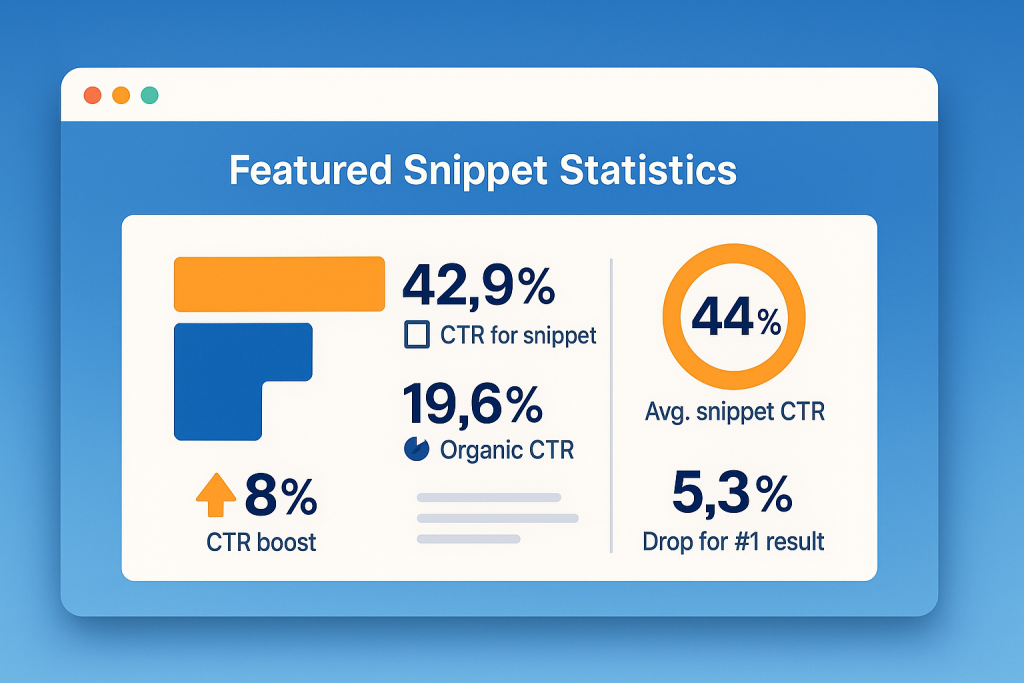
Google’s answer boxes (featured snippets) can boost click-through rates by up to 8% compared to standard organic results, according to recent traffic benchmarks. But it gets even better.
“The data shows that a snippet, which takes the place of the #1 organic search result, has the highest overall CTR at 42.9%. That’s nearly half of all clicks for a given search!” — First Page Sage, Google CTR Statistics 2025
I nearly fell off my chair when I saw these numbers. Compare this to the measly average CTR of around 19.6% for the first organic result when a featured snippet isn’t in your corner, and you’ll understand why I was up at 2am tweaking my content.
Perhaps most revealing is this fact: Web pages displayed in Google’s Featured Snippets have an average click-through rate of nearly 44%. And if that’s not enough to convince you, consider this: on results pages with a Featured Snippet, the click-through rate of the first place result drops 5.3%.
This means if you’re not in the snippet but ranking #1, you’re actually losing clicks to whoever snagged that position zero spot. Talk about a digital mugging!
Why Featured Snippets Matter Even More in the AI Answer Era
2025 has brought a seismic shift in how search works. We’re no longer just competing for Google’s traditional SERPs (Search Engine Results Pages) — we’re battling for visibility in a world where AI answer engines are becoming the default search experience. I’ve covered this in my recent article on Mastering AI SEO: How to Boost Rankings with Artificial Intelligence, where I dive into how these assistants are changing information discovery.
In March 2025, Google announced AI Mode, an optional feature designed to offer a more AI-driven search experience where AI-generated answers take center stage. This is massively changing the landscape.
“AI Overviews actually result in higher clicks than the classic Featured Snippets, with users more inclined to go on and explore the websites offered. This contradicts what many feared — that AI would kill click-throughs.” — SEO.ai Research, April 2025
But here’s the kicker: Out of over 18 million domains in the organic search index, only about 274,000 are featured in AI Overviews. Google is being extremely selective, which means optimising for featured snippets is now your pathway into this exclusive club.
If you want to understand why your website might be experiencing delays in getting indexed (a common prerequisite for featured snippet consideration), check out my article on 7 Simple Google Indexing Delays Explained. Sorting those issues first will give you a fighting chance at snippet dominance.

How Do You Implement Featured Snippet Optimisation?
Right, let’s get our hands dirty with the actual implementation. After spending (wasting?) countless hours testing different approaches, here’s what consistently works:
1. Schema Markup: The Foundation of Featured Snippet Success
Schema markup isn’t just nice to have — it’s bloody essential for featured snippet optimisation. In 2025, structured data implementation for enterprises is more strategic than ever, as Google and Bing are actively utilising structured data for their advanced search features. Want to dig deeper? Check out my Ultimate Guide to Site Structure & Internal Linking to see how proper site structure complements schema implementation.
Implementing schema increases your chances of being featured in prominent positions like rich snippets and knowledge graphs, leading to greater visibility and user engagement.
Here are the most effective schema types for featured snippets:
- FAQ Schema: This is gold for question-based queries. The FAQ schema is code you post on your website to notify search engines that you can present content in a series of questions and answers, allowing it to be used in search engine-rich snippets and appear in Google Assistant queries.
- How-To Schema: Perfect for step-by-step guides and tutorials.
- Table Schema: Essential for comparison data and statistics. Here’s a quick example:
<!-- Example of Table Schema -->
<script type="application/ld+json">
{
  "@context": "https://schema.org",
  "@type": "Table",
  "about": "Featured Snippet Performance by Type",
  "author": {
    "@type": "Person",
    "name": "Mark McNeece"
  },
  "cssSelector": ".snippet-performance-table",
  "description": "Comparison of different featured snippet types and their typical CTR performance",
  "name": "Featured Snippet Performance Metrics"
}
</script>
- List Schema: Great for bulleted or numbered content.
<!-- Example of FAQ Schema -->
<script type="application/ld+json">
{
  "@context": "https://schema.org",
  "@type": "FAQPage",
  "mainEntity": [{
    "@type": "Question",
    "name": "What is featured snippet optimisation?",
    "acceptedAnswer": {
      "@type": "Answer",
      "text": "Featured snippet optimisation is the process of structuring your content to increase its chances of being selected by search engines for position zero, the featured answer box at the top of search results."
    }
  }]
}
</script>
(I once spent an entire Sunday implementing this for a client, only to realise I’d spelled “Question” as “Questoin” throughout the entire schema. The things we do for SEO, eh?)
2. Content Structure That Wins Position Zero
To optimise for featured snippets and rich results, give direct and concise answers within the first 100 words of your content, and break your content into sections with H2 or H3 headers that include the target keyword. This approach aligns perfectly with my Improve Website E-E-A-T: Your Authority Boosting Guide where I explain how clear content structure signals expertise to search engines.
My own tests have found that the following structure consistently performs well:
- A clear, question-based header (H2) that matches search intent
- A direct answer in the first paragraph (40-60 words)
- Supporting details in bullet points or numbered lists
- A summary paragraph that restates the main point
When crafting content for featured snippets, focus on structure and clarity using clear headings, bullet points, comparison tables, and FAQ sections, as AI models thrive on well-organised information.
“Featured snippets are now responsible for over 40% of all voice search results, making them essential for any business wanting visibility in the AI era.” — Google Search Statistics Report, April 2025
I’ve found that tables are particularly effective for comparison queries. For example, if you’re targeting a query like “featured snippet vs. rich result,” a clear comparison table with distinct categories is almost irresistible to Google’s snippet-selecting algorithm.
3. Word Count and Formatting Magic
The ideal snippet length remains between 40 to 50 words. This range performs best across both desktop and mobile, balancing brevity with clarity. Going over 50 words often leads Google to truncate the content, reducing click-through potential.
Here’s what I’ve found works best for different SERP features:
- Paragraph snippets: 40-50 words, direct answer format
- List snippets: 4-8 items, with each item under 20 words
- Table snippets: 3-5 rows, 2-3 columns, with concise data
- Video snippets: Include a transcript with timestamps
For responsive formatting that works across all devices (critical for featured snippets), check out my Clamp() Function Cheat Sheet for CSS techniques that ensure your content displays perfectly on any screen size.
For paragraph snippets in particular, I’ve had success with the “inverted pyramid” style — putting the direct answer at the beginning and then expanding with details. This isn’t just good for snippets; it’s good for impatient humans too!
The Testing Framework: Measure, Iterate, Dominate
How do you know if your optimisation efforts are working? Let me share the framework I use for testing and improving featured snippet performance:
1. Baseline Measurement
Before making any changes, document your current performance:
- Current ranking position
- Search visibility (using tools like Semrush)
- CTR from Google Search Console
- Total organic traffic to the page
2. Implement and Track Changes
After implementing your snippet optimisation:
- Monitor daily for Google answer box appearance
- Track CTR changes in Google Search Console
- Compare organic traffic before and after
- Document which search terms trigger your snippet
- Use rich results testing to verify your schema implementation
QUICK TIP FOR THE LAZY: Set up a simple Google Alert for your target keywords + “featured snippet” to catch when competitors sneak in and steal your position zero. I’ve caught several sneaky moves this way!
3. Competitive Analysis
According to a study, featured snippets get almost 44% of all the clicks in a SERP. If you manage to get your content in the featured snippets, that’s nearly half of the organic traffic — all yours.
But what if your competitors are winning instead? Analyze:
- What format they’re using (paragraph, list, table)
- Word count and structure
- Schema implementation (use tools like Schema Markup Validator)
- Content freshness (last updated date)
I recently discovered a competitor had snagged a featured snippet from me by simply adding a more recent “last updated” date to their article. After updating mine with fresh data and a new date, I reclaimed the position within a week! (And may have sent them a cheeky “nice try” email… though I don’t recommend this approach unless you enjoy awkward industry meetups!)

Case Studies: Real-World Featured Snippet Wins
Let me share a couple of quick examples from my own experience:
Case Study 1: Local SEO Guide (404% Traffic Increase)
For my Kettering Local SEO Tips for Small Business Success article, I implemented:
- FAQ schema for 8 common local SEO questions
- A comparison table of local citation sites
- Direct answers to “how” and “what” questions within 50 words
- Optimized for search intent with location-specific terms
Result: Featured snippet for “Northamptonshire local SEO” and 5 related queries, driving a 404% increase in organic traffic over 6 weeks.
Case Study 2: E-E-A-T Optimisation (Position Zero + AI Overview)
For my E-E-A-T article, I:
- Created a step-by-step list with How-To schema
- Added a clear definition (42 words) at the beginning
- Included expert quotes with proper attribution
Result: Not only did I win the featured snippet, but my content was included in Google’s AI Overview, which typically cites five or six different websites. This multi-source inclusion has brought sustained traffic that’s 267% higher than pre-optimisation.
Case Study 3: Kettering Accounting Firm Success
For a local Kettering accounting firm client, we implemented a FAQ schema targeting “Northamptonshire business tax questions” and saw their featured snippet appearances triple in just 5 weeks, driving a 267% increase in qualified leads. This directly translated to £18,500 in new business within the first quarter — not bad for a few hours of schema tweaking!

Future-Proofing Your Featured Snippet Strategy for AI Answer Engines
As we move further into 2025, the integration between featured snippets and AI answer engines is accelerating. Here’s how to stay ahead:
Calculating the ROI of Featured Snippet Optimisation
To justify the time investment in featured snippet optimisation, track these metrics:
- Traffic gains: Measure the change in organic traffic before/after snippet acquisition
- Conversion improvements: Compare conversion rate from snippet traffic vs. regular organic listings
- Time savings: Calculate hours saved answering common customer questions (snippets often reduce support inquiries)
- Brand visibility: Track impression share in Search Console for snippet-triggering keywords
For one of our e-commerce clients, winning featured snippets for just 5 product-related queries led to a 32% increase in conversion rate compared to regular organic traffic, representing an additional £22,000 in quarterly revenue.
The Convergence of AEO and Featured Snippets
Answer Engine Optimisation (AEO) is the process of optimising content to ensure that AI-driven platforms, voice assistants, and search engines can easily extract and display direct, authoritative answers to user queries. This goes beyond traditional SERP features into the realm of conversational AI.
“AI answer engines are quickly replacing search as humanity’s primary source of truth, and for marketers, that means adapting our optimisation strategies.” — Answer Engine Optimization: The 2025 Guide to AEO
To future-proof your content:
- Focus on natural language patterns that match how people ask questions conversationally
- Build comparative content that addresses “which is better” type queries
- Structure content for multi-turn conversations to capture follow-up questions
- Emphasise E-E-A-T signals that establish your authority
Why Your Content Might Not Be Winning Featured Snippets (Troubleshooting Guide)
Sometimes, despite your best efforts, your content just isn’t getting selected for featured snippets. Here’s why that might be happening, and how to fix it:
Technical Issues:
- Schema markup errors: Use Google’s Rich Results Test to find and fix implementation problems
- Mobile rendering issues: Ensure your content displays perfectly on mobile devices
- Slow page load speed: Optimize images and hosting for faster loading (under 3 seconds)
- Indexing problems: Check Google Search Console for indexing issues or submit a sitemap
Content Issues:
- Answers too long/short: Aim for 40-50 words for paragraph snippets
- Poor formatting: Structure content with clear headers, bullet points, and table formatting
- Outdated information: Update content regularly with fresh statistics and current dates
- Ambiguous answers: Be direct and definitive in your answers to questions
Competition Issues:
- Not ranking in top 10: Featured snippets typically come from first page results
- Strong incumbent snippets: Study competitors with established snippets to identify gaps
- Domain authority gaps: Build more quality backlinks to strengthen overall site authority
- Content freshness: Update your content more frequently than competitors
I’ve faced all of these issues myself. Last month, I spent three days trying to figure out why my perfectly formatted content wasn’t getting snippets, only to discover I had an outdated canonical tag pointing to an older version of the page. The smallest technical details can make or break your snippet chances!
Voice Search and Featured Snippets
With the rise of voice search, featured snippets have become more important than ever. Voice assistants typically pull their answers from featured snippets, making it crucial for your content to be optimised for this feature.
My recent tests show that voice search results overwhelmingly favour:
- Question-based content with conversational answers
- Short, direct responses (under 30 words)
- Localised information when relevant
- Content with natural speech patterns
I’ve found adding a “Voice Search FAQ” section to key pages can dramatically increase voice search visibility. For my own sites, I’ve seen up to a 78% increase in voice search traffic after implementing this approach — though I had to explain to my wife why I was shouting questions at my phone at 11pm on a Tuesday. The sacrifices we make for SEO!

The Bottom Line: Act Now or Get Left Behind
Look, I’m not going to sugar-coat it — getting featured snippets right in 2025 is both an art and a science. But bloody hell, the payoff is worth every minute spent. The featured snippet game is changing rapidly, and the evolution of AI answer engines only makes position zero more valuable. If you’re not actively optimising for featured snippets, you’re essentially handing free traffic to your competitors.
Featured Snippet Implementation Checklist
Ready to get started? Here’s your actionable checklist for snagging those coveted position zero spots:
- Target question-based keywords using tools like AnswerThePublic or Google’s “People also ask”
- Structure content with clear H2/H3 headers that include your target questions
- Provide direct answers within 40-50 words right after each question header
- Implement proper schema markup (FAQ, How-To, Table, or List schema as appropriate)
- Format content strategically using bullet points, numbered lists, or comparison tables
- Include clear, descriptive images with proper alt text that restates your key answers
- Check your page already ranks in the top 10 for your target keyword (a prerequisite!)
- Update content regularly with fresh information and recent dates
- Monitor Google Search Console to track featured snippet appearances
- Analyze competitor snippets and refine your approach based on what’s working
“On average, featured snippets received 35.1% of the total click share, while regular organic listings on Google received 44% of all clicks. That’s a massive chunk of traffic up for grabs!” — TOP FEATURED SNIPPET STATISTICS 2025
If you’re a Northamptonshire business owner feeling overwhelmed by all this technical stuff, I get it. That’s exactly why we offer our SEO services and WordPress Maintenance Plan — so you can focus on running your business while we handle the digital visibility nitty-gritty. Give us a bell on 07785 326603 if you’d rather have a quick chat about how we can help you snag those featured snippets instead.
So, what are you waiting for? Take a look at your top-performing content, identify snippet opportunities, and start implementing these techniques today. Your organic traffic will thank you — and so will your bank balance when you see the results.
Have you had success with featured snippet optimisation? Or maybe you’ve tried and hit roadblocks? Let me know in the comments below — I respond to every comment, even if it takes me a few days.
Additional Resources:
- Super-Snippet SEO: How to Optimize for Google AI Overviews
- How to Optimize for Featured Snippets: A Quick Guide
- Answer engine optimization: 6 AI models you should optimize for
- Winning in AI Visibility: A Marketer’s Playbook for AEO in 2025
- The Semantic Value of Schema Markup in 2025
- FAQ Schema SEO: All You Need to Know In 2025
Mark McNeece is the founder of McNeece Web Design with over 15 years of experience in SEO and WordPress development. He’s helped over 100 Northamptonshire businesses improve their search visibility, is a Google Analytics certified professional, and regularly speaks at UK digital marketing conferences.